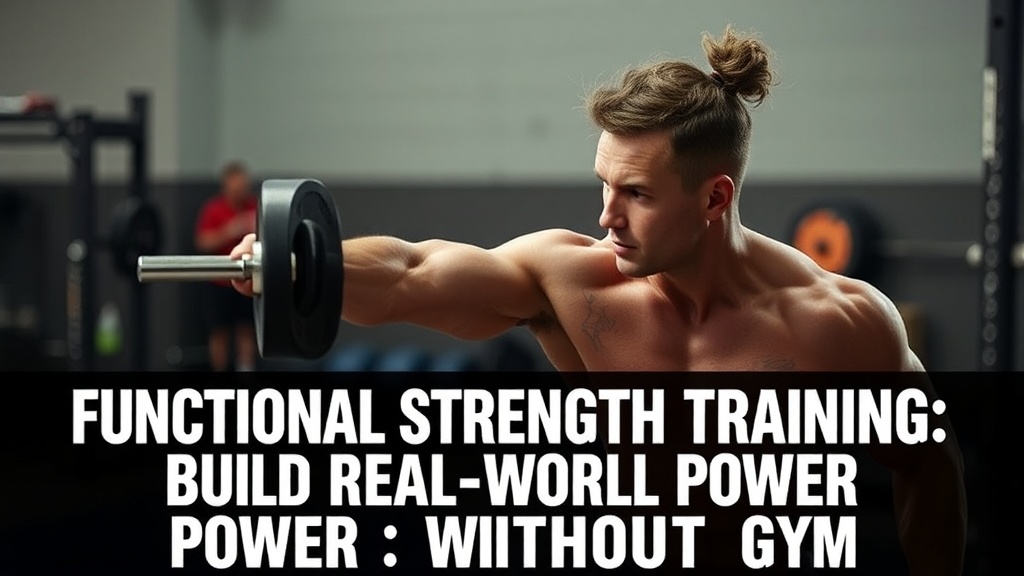
Functional Strength Training: Build Real-World Power Without the Gym

Functional strength training focuses on movements that translate directly to everyday life—lifting groceries, climbing stairs, or chasing after kids. Unlike traditional gym workouts that isolate muscles on machines, this approach builds coordinated power that actually matters outside the weight room. Here's how to develop real-world strength without ever stepping foot in a commercial gym.
What Is Functional Strength Training?
Functional strength training prepares the body for daily activities through compound, multi-joint movements. Rather than targeting a single muscle group (like a bicep curl isolating the front of the arm), functional exercises engage multiple muscles simultaneously—mimicking how the body naturally moves. Think squats, lunges, pushes, pulls, and rotations. These patterns recruit core stabilizers, improve balance, and develop coordination that machine-based workouts often neglect.
The key difference lies in intent. A leg press machine builds quad strength, sure—but it does so while the body sits fixed in place. Real life doesn't come with padded seats and guided tracks. Functional training happens standing, shifting, and stabilizing. The payoff? Better posture, reduced injury risk, and the ability to move through the world with confidence.
Can You Build Real Strength at Home Without Equipment?
Absolutely—bodyweight exercises form the foundation of functional training and can develop impressive strength when programmed correctly.
The catch? Progressive overload still matters. Without adding weight plates, you increase difficulty through leverage, tempo, volume, and mechanical disadvantage. A standard push-up becomes harder with feet elevated. A squat deepens with a pause at the bottom. A lunge gains complexity when performed on an unstable surface (a folded towel works wonders).
Here's a comparison of bodyweight progressions:
| Movement Pattern | Beginner Version | Intermediate Version | Advanced Version |
|---|---|---|---|
| Push | Wall push-up | Standard push-up | Pike push-up or dive bomber |
| Pull | Dead hang | Bodyweight row (table edge) | Pull-up or chin-up |
| Squat | Box squat to chair | Bodyweight squat | Pistol squat or shrimp squat |
| Hinge | Glute bridge | Single-leg Romanian deadlift | Nordic hamstring curl |
| Carry | Farmer's walk (grocery bags) | Single-arm suitcase carry | Overhead carry (water jug) |
Worth noting: research published by the National Institutes of Health demonstrates that bodyweight training produces similar strength and hypertrophy outcomes to traditional resistance training when volume and effort are matched. The body doesn't distinguish between iron plates and creative physics—it responds to mechanical tension and progressive challenge.
What Household Items Work Best as Free Weights?
Backpacks filled with books, water jugs, sandbags, and even toddlers (carefully!) provide adjustable resistance that rivals expensive dumbbells.
The humble backpack deserves special recognition. Load it with heavy objects—textbooks, rice bags, detergent containers—and you've got a versatile weight for squats, lunges, presses, and rows. Adjust the load by adding or removing items. Wear it on the front (bear hug style) for goblet squats. Sling it over one shoulder for asymmetric carries that torch the core.
Water jugs offer unique advantages. A gallon of water weighs approximately 8.3 pounds—fill two and you've got a pair of adjustable dumbbells. The shifting liquid creates an unstable load, forcing stabilizer muscles to work harder than they would with solid weights. Try overhead presses or Turkish get-up variations with a partially filled jug and feel the difference immediately.
Other household champions include:
- Towels — create sliding surfaces for lunges, hamstring curls, and core exercises on hardwood or tile
- Stairs — nature's step-up platform and calf raise station
- Broomsticks or PVC pipes — lightweight tools for mobility drills, overhead squats, and rotation work
- Chairs or sturdy tables — platforms for incline push-ups, Bulgarian split squats, and bodyweight rows
- Bedsheets — looped over a door frame (securely!) for suspension trainer-style rows and curls
Felix Vega regularly trains clients with nothing more than a loaded backpack and a park bench. The results speak for themselves—strength isn't about the equipment, it's about consistent, progressive effort.
How Does Functional Training Compare to Gym Workouts?
Both approaches build strength, but functional training develops movement quality and real-world applicability that machine-centric gym routines often miss.
Traditional gym workouts excel at targeted muscle development. Want bigger biceps? Curls work. Want massive quads? Leg extensions deliver. That said, these gains don't always transfer to practical capability. The guy who leg-presses 400 pounds might struggle to lift a heavy box from the floor—his core never learned to brace while standing, his stabilizers never activated in a real-world pattern.
Functional training prioritizes movement patterns over muscles. A kettlebell swing (or its backpack-filled equivalent) develops hip power, grip endurance, and cardiovascular conditioning simultaneously. The movement pattern—hip hinge, explosive extension, controlled deceleration—translates directly to lifting a heavy suitcase into an overhead compartment or hoisting a bike onto a car rack.
The American Council on Exercise recommends integrating functional movements for improved balance, coordination, and fall prevention—particularly important as people age. Real strength means maintaining independence, not just filling out a t-shirt.
What Does a Weekly Functional Strength Program Look Like?
Three to four sessions per week hitting all major movement patterns creates sustainable progress without equipment.
Here's the thing—consistency beats perfection. A simple program done regularly outperforms a complex routine abandoned after two weeks. The following template requires zero equipment and builds comprehensive functional fitness:
Day 1: Push & Hinge Focus
- Push-ups: 3 sets of 8-15 reps (modify by elevating hands on a counter if needed)
- Single-leg Romanian deadlifts: 3 sets of 10 per leg
- Pike push-ups or downward dog push-ups: 3 sets of 6-10
- Glute bridges: 3 sets of 15-20
- Plank hold: 3 sets of 30-60 seconds
Day 2: Pull & Squat Focus
- Bodyweight rows (using table edge or bedsheet): 3 sets of 8-12
- Split squats or Bulgarian split squats: 3 sets of 10 per leg
- Superman holds: 3 sets of 20-30 seconds
- Cossack squats (lateral squats): 3 sets of 8 per side
- Dead bug: 3 sets of 10 per side
Day 3: Carry, Rotate & Full Body
- Farmer's walk with loaded bags: 3 rounds of 60 seconds
- Inchworms: 3 sets of 8 reps
- Side plank with rotation: 3 sets of 8 per side
- Bodyweight squats with 3-second pause: 3 sets of 12-15
- Bear crawls: 3 sets of 30 seconds
Add loaded carries whenever possible. Carrying heavy things—whether groceries from the car, a loaded backpack on a walk, or water jugs held overhead—builds grip strength, core stability, and mental toughness that no crunch or curl can replicate.
Why Do So Many People Quit Home Workouts?
Lack of clear progression and monotous routines kill motivation faster than any other factor.
Without the gym's structured environment—equipment variety, scheduled classes, other people working out—home exercisers often fall into repetitive patterns. Same exercises. Same reps. Same lack of visible progress. The solution lies in systematic progression and environmental variety.
Track your workouts. Write down reps, sets, and how each felt. When standard push-ups get easy, elevate your feet. When bodyweight squats feel light, slow down the descent—take four seconds to lower, pause at the bottom, explode up. These small tweaks keep the stimulus challenging and the body adapting.
Environmental variety matters too. Train in different rooms. Move outside when weather permits. A park bench becomes a box for step-ups or incline push-ups. A playground offers pull-up bars and monkey bars for hanging and brachiation (great for shoulder health). The Journal of Strength and Conditioning Research suggests outdoor exercise enhances mood and adherence compared to indoor training—worth considering for long-term consistency.
"Strength built through functional movement doesn't just change how you look—it changes how you experience daily life. The stairs feel easier. The groceries feel lighter. Confidence in your body's capability bleeds into every other area."
Start where you are. Use what you have. Do what you can. The gym industrial complex wants you to believe fitness requires monthly memberships, fancy equipment, and branded apparel. It doesn't. Real functional strength lives in the consistent practice of moving well, progressing gradually, and showing up—even when the only weight available is a loaded backpack and the determination to improve.